
Budapest & Local Tips · 9 min read
Cash or Card in Budapest? Money, ATMs & Currency Explained
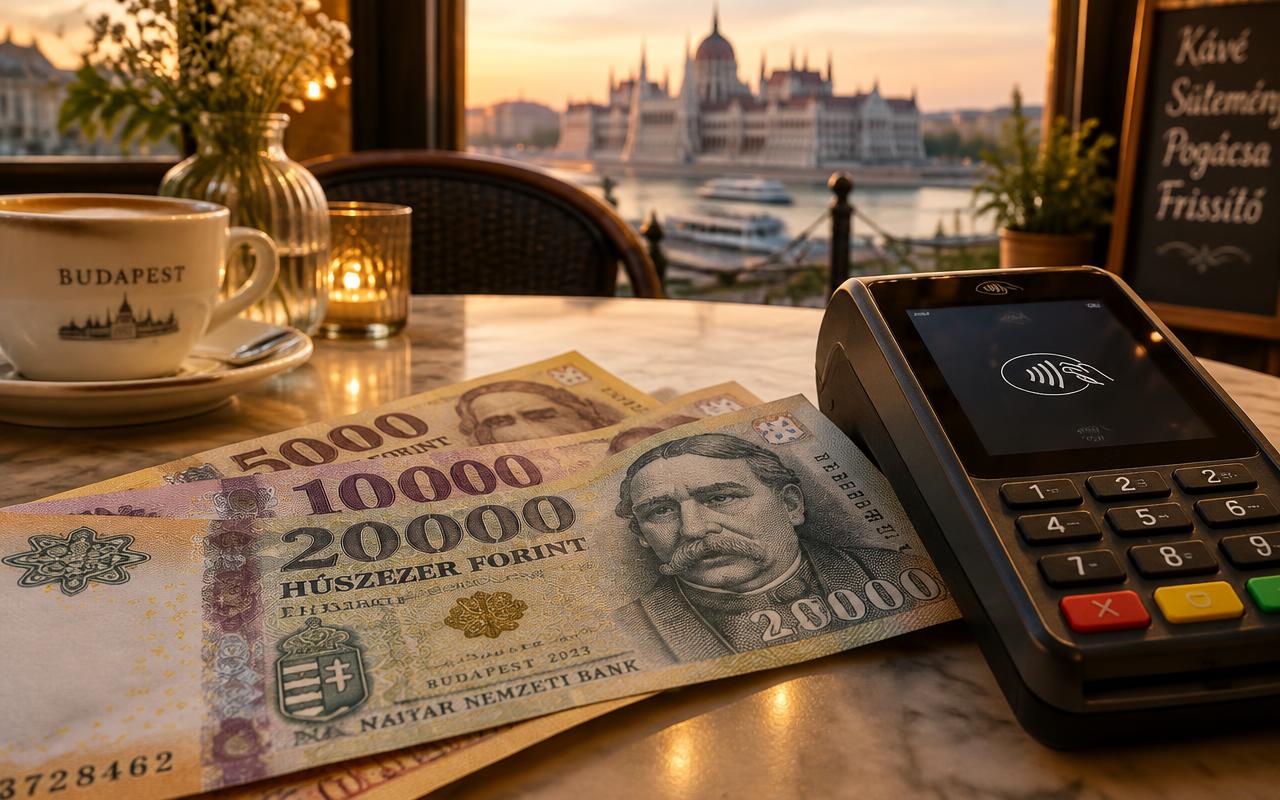
“Do I need cash?” is one of the most common questions first-time visitors ask me — often followed by “Should I bring euros?” and “The card machine asks dollars or forints — which one?”. The good news: paying in Budapest is straightforward. Cards work for most purchases, you don't need a lot of cash, and ATMs are everywhere. But a few details, especially currency conversion, are worth understanding.
This article is part of our complete Budapest guide: 10 Things to Know Before Visiting Budapest for the First Time
What currency does Budapest use?
Hungary's official currency is the Hungarian forint, written HUF or Ft — a bill of 18,500 Ft means 18,500 forints. Hungary is in the EU but not the euro area.
Banknotes: 500, 1,000, 2,000, 5,000, 10,000 and 20,000 Ft. Coins: 5, 10, 20, 50, 100 and 200 Ft (Magyar Nemzeti Bank). You don't need to memorise them — just think in HUF.
Can you pay by card?
Yes — for most visitors, card will be the main way to pay. The Hungarian National Bank says card payment is accepted at more than 150,000 merchant locations. Visa and Mastercard are common and contactless is normal.
Hotels, restaurants, cafés, groceries, museum and thermal bath tickets and taxis can usually be paid without cash. Still, keep a small amount of forints with you.
So, do you need cash?
A little, yes. A large amount, usually not. A small business may have a terminal problem, a market stall may prefer cash, and cash is handy for small direct tips. Think of cash as a backup, not the way to finance the trip.
Can you pay in euros?
Sometimes — but don't plan to. Businesses accepting euros set their own exchange rate, which may be less favourable, and change may come back in forints (Visit Hungary warns about this).
Simple rule: if something is priced in forints, pay in forints whenever practical.
HUF or EUR/USD on the card machine? This is important
You tap your foreign card for a 25,000 HUF dinner and the terminal offers “Pay 25,000 HUF” or “Pay in USD / EUR / GBP”. The second option is usually Dynamic Currency Conversion (DCC): the merchant's system converts immediately, and Visa notes DCC can include its own rate plus fees or markup.
Choosing HUF leaves the conversion to your own card according to its terms. Your bank may still charge foreign transaction fees, but you avoid the DCC markup. The MNB has also warned DCC can be more expensive.
HUF or USD? → HUF. HUF or EUR? → HUF. HUF or GBP? → HUF.
The same rule applies at ATMs
An ATM may offer to “Accept conversion” or “Continue without conversion”. The second option is not risky — it keeps the withdrawal in forints, converted through your card. Withdraw HUF, read every screen and review any conversion offer before accepting.
Which ATM should you use?
ATMs are easy to find. Prefer ones operated by recognised banks. The ATM operator and your own bank are two different parties — either may charge a fee — so check your bank's international ATM terms before travelling.
- How much HUF you are withdrawing
- Whether the ATM charges its own fee
- Whether your bank charges an international ATM fee
- Whether currency conversion is being offered, and which currency you accept
Should you exchange money at the airport?
You can, but official tourism guidance notes airport exchange rates are generally less favourable — exchange only the minimum if you need cash immediately. Later, use an established exchange office or bank, check the rate and commission, and never exchange money with someone who approaches you on the street.
Bringing forints from home is usually unnecessary. More important is knowing what your bank charges for foreign card payments and ATM withdrawals.
Apple Pay, contactless and American cards
Mobile wallets work wherever contactless card payments are accepted, but carry a physical card too — and ideally a second one stored separately. Phones run out of battery.
American visitors should check two things: foreign transaction fees on their card, and ATM terms — withdrawing with a credit card may count as a cash advance with extra fees or interest.
Cash, card and tipping
Many restaurants let you add a tip on the card terminal. But first check whether the bill already includes a service charge (szervizdíj) — it is not the same as a voluntary tip.
Read the full guideTipping in Budapest: A Practical Guide for VisitorsA simple payment strategy
- Use your card for most purchases.
- Pay in HUF when given a currency choice.
- Keep a small amount of HUF cash as backup, in smaller notes.
- Use established ATMs and read the screen before accepting conversion.
- Check your bank's foreign transaction and ATM fees before travelling.
- Don't rely on euros for everyday spending.
Common money mistakes
- Paying in euros without checking the exchange rate.
- Automatically choosing USD, EUR or GBP on the terminal (DCC).
- Accepting ATM conversion without reading the screen.
- Withdrawing more cash than needed.
- Using the first exchange desk without comparing rate and commission.
- Forgetting to check your own bank's fees.
Quick guide: cash or card?
| Situation | Practical choice |
|---|---|
| Restaurant, café, hotel, supermarket | Card |
| Thermal bath, museum | Card is generally practical |
| Small market / vendor | Have some cash |
| Taxi | Card widely available; confirm if needed |
| Tips | Card or cash depending on the business |
| ATM | Withdraw HUF, review conversion carefully |
| Terminal asks HUF or home currency | Usually choose HUF |
| Paying in euros | Possible, but generally unnecessary |
| Currency exchange | Compare rate and commission first |
Bottom line: mostly card, with a little cash. The local currency is HUF — pay in HUF and check conversion offers before accepting them.
Frequently Asked Questions
- Do I need cash in Budapest?
- Not large amounts. Cards are widely accepted in shops, restaurants and hotels, but keeping some forints as backup is useful.
- What currency is used in Budapest?
- The Hungarian forint (HUF). Hungary does not use the euro.
- Can I pay in euros in Budapest?
- Some businesses accept euros voluntarily, but their rate may be less favourable and change may be returned in forints.
- Should I choose HUF or EUR when paying by card?
- Usually HUF. Paying in HUF avoids the merchant's Dynamic Currency Conversion, which may include a markup or fees.
- Should Americans choose HUF or USD in Budapest?
- The same principle applies: HUF avoids the terminal's DCC conversion. Your card issuer may still apply its normal foreign transaction fees.
- Can I use my credit card in Budapest?
- Yes, major international cards are widely usable at hotels, restaurants, shops and other established businesses.
- Are there ATMs in Budapest?
- Yes, widely. Check both the ATM operator's charges and your own bank's fees before confirming.
- Should I exchange money at Budapest Airport?
- You can, but airport rates are generally less favourable. Exchange only what you need immediately.
- How much cash should I bring to Budapest?
- There is no fixed amount. Cash works best as a backup; use cards for everyday spending and withdraw HUF if needed.
Last updated: 2026-09-26