
Budapest & Local Tips · 8 min read
Tipping in Budapest: A Practical Guide for Visitors
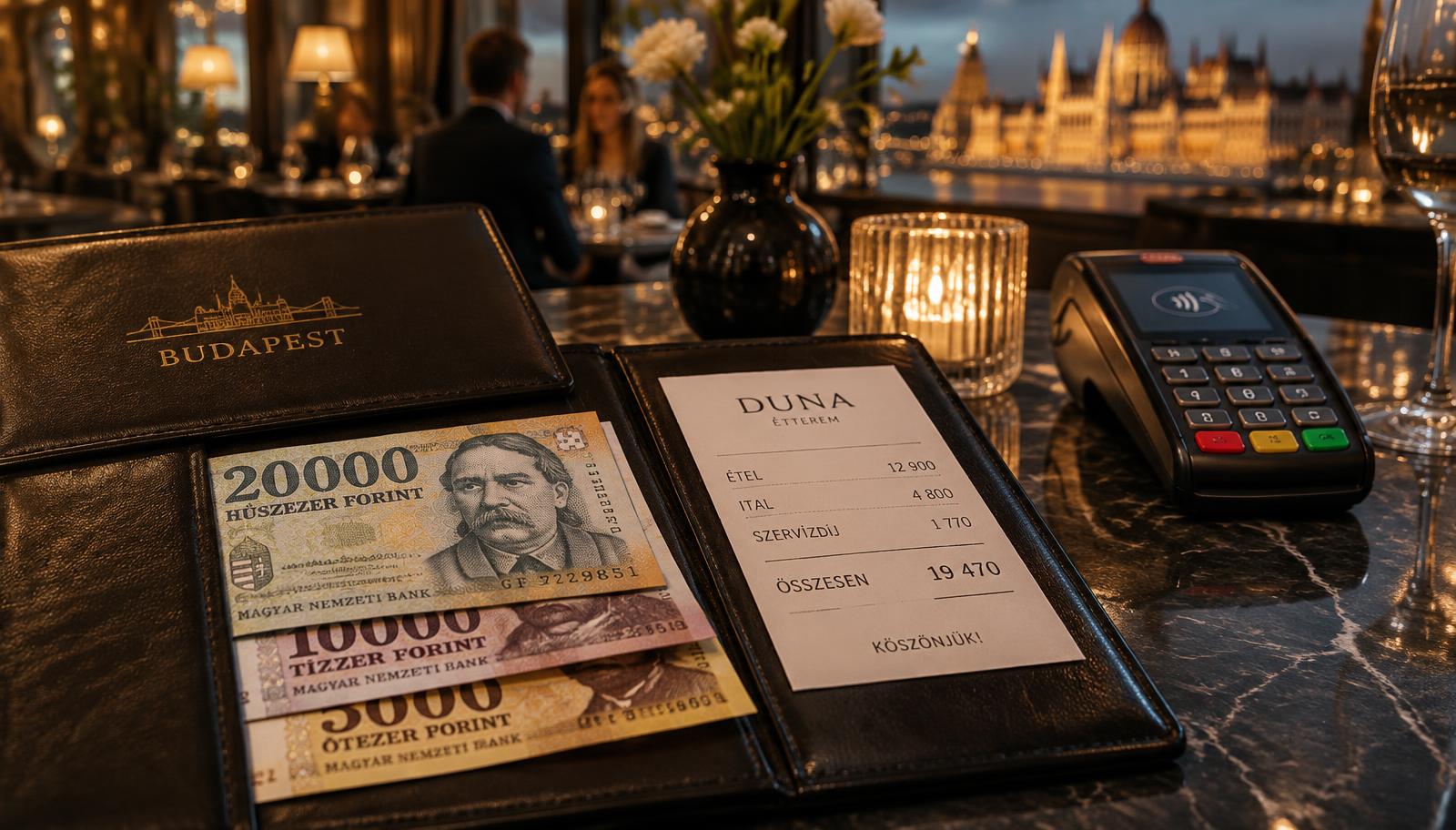
Tipping is common in Hungary, but it does not work the way many American visitors are used to. It is voluntary, there is no universal percentage, and in many restaurants a service charge is already on the bill. Here is what you need to know before your first meal, taxi ride or private transfer in Budapest.
Is tipping expected in Budapest?
Yes, tipping is a familiar part of everyday life, particularly in restaurants, cafés, bars and some personal services. But there is an important difference between customary and mandatory.
A tip — borravaló in Hungarian — is voluntary: you decide whether and how much to give. A service charge, szervizdíj or felszolgálási díj, is added by the business, and once it is on the bill it is part of what you owe. The Hungarian Competition Authority specifically advises consumers to distinguish between the two.
First rule: check the bill before you decide how much to tip.
How much should you tip?
In a restaurant where no service charge has been added, around 10–15% is a reasonable guideline for good service. You do not need to calculate 20% simply because you would at home.
| Bill | 10% tip | 15% tip |
|---|---|---|
| 10,000 HUF | 1,000 HUF | 1,500 HUF |
| 20,000 HUF | 2,000 HUF | 3,000 HUF |
| 30,000 HUF | 3,000 HUF | 4,500 HUF |
| 50,000 HUF | 5,000 HUF | 7,500 HUF |
These are guidelines, not mandatory amounts. Ordinary service, stay at the lower end; exceptional service, give more if you want to.
The most important thing: check for a service charge
Look at your bill for wording such as service charge, service fee, szervizdíj or felszolgálási díj. If a service charge is already included, you generally do not need to add another percentage.
For private customers the customer-facing service charge is currently limited to 15% under Hungarian regulations. So if your bill shows food and drinks of 40,000 HUF plus a 15% service charge of 6,000 HUF, the 46,000 HUF total is what you owe. An extra voluntary tip is possible, but not expected.
Why is there a service charge at all?
A service charge is not simply another word for a tip. According to the Competition Authority it is a regulated charge connected to the work of serving staff, distributed among eligible employees according to the establishment's rules.
A voluntary tip is different, because the customer decides whether to give it and how much. When you see szervizdíj, think: this is already on my bill. When you consider a borravaló, think: do I personally want to thank the staff?
Restaurants, cafés and bars
Restaurants are where tipping matters most. Without a service charge, 10–15% is a common guideline for good table service; with one, simply pay the total shown.
Cafés are more relaxed. Ordering a coffee at the counter rarely calls for a percentage tip; for table service, rounding up is common — a 3,700 HUF coffee and cake becomes 4,000 HUF. Bars follow the same logic: optional at the counter, a small extra for attentive table service through the evening.
Taxis
Around 10% is commonly cited, particularly for longer journeys or when the driver helps with luggage. For short trips, rounding up is normal: a 4,700 HUF fare becomes "5,000, please."
Remember that the fare is what you owe for the journey; the tip is an optional expression of appreciation.
Private drivers and chauffeurs
A private transfer is different from a taxi. The agreed price normally covers the service you booked, and there is no Hungarian rule requiring a percentage tip on a private transfer.
If your driver helps with luggage, waits patiently for a delayed flight or makes your arrival significantly easier, you may choose to give something — some travel guides suggest 5–10%, but that is an industry recommendation, not a local rule. Rounding up is equally fine.
You should never feel obliged to tip a private driver for a service you have already paid for. A gratuity is an optional thank-you for going beyond expectations.
Tour guides, hotels and spas
For a paid private tour, tipping is optional but appreciated when the guide has clearly adapted the experience to you; around 10% is sometimes used as a guideline. Free walking tours are different — they run on a tip-based model, so what guests give is essentially the guide's income.
Hotel tipping is more modest: a small amount for a porter who carries your luggage or a staff member who goes out of their way. At thermal baths you do not tip for entry, but a gratuity can be appropriate after a massage or personal treatment.
Can you tip by card?
Yes, many businesses allow it, though the exact process varies. A terminal may offer 0%, 10%, 15% or 20% — do not assume you must choose one, and check first whether a service charge is already included.
Hungarian tax rules have also changed: since 2025 qualifying tips can receive tax-exempt treatment even when paid by card, which is why more places now offer the option.
Quick Budapest tipping guide
| Service | Typical approach |
|---|---|
| Restaurant, no service charge | Around 10–15% |
| Restaurant with service charge | No additional tip required |
| Café | Round up or small tip for table service |
| Bar | Optional; something extra for table service |
| Taxi | Round up; around 10% is common |
| Private driver / chauffeur | Optional; no fixed percentage |
| Paid tour guide | Optional; around 10% sometimes used |
| Free walking tour | The tip is the model |
| Hotel porter | Small tip for assistance |
| Spa / massage | Optional for personal treatment |
| Retail, supermarket, public transport | No tip expected |
7 tipping mistakes to avoid
- Automatically adding 20% because that is the habit at home
- Tipping twice — check for szervizdíj before adding a percentage
- Assuming a card terminal's tip prompt must be answered
- Confusing the service charge with a tip; they are different things
- Giving a large tip simply because you are a tourist
- Worrying about the exact percentage instead of the gesture
- Forgetting to check the bill at all — the easiest mistake to avoid
Five seconds before you pay
That is it. No formula, no awkwardness — just a small piece of local knowledge that makes travelling in Budapest a little easier. And if someone genuinely made your day easier, a simple "köszönöm" goes a long way too.
- Check the total
- Look for szervizdíj or service charge
- If it is included, you generally do not need to add more
- If it is not, and you were happy, 10–15% is a reasonable guideline
- Pay the amount you are comfortable with
Frequently Asked Questions
- Do you tip in Budapest?
- Yes, tipping is customary but voluntary. In restaurants around 10–15% is a common guideline when no service charge has been added.
- What is szervizdíj on a Budapest restaurant bill?
- Szervizdíj (or felszolgálási díj) is a service charge added by the restaurant. Once it appears on the bill it is part of what you owe, and you generally do not need to add another tip.
- How much do you tip a taxi driver in Budapest?
- Around 10% is commonly cited, especially for longer rides or when the driver helps with luggage. Rounding up to a convenient amount is perfectly normal.
- Should you tip a private driver or chauffeur in Budapest?
- There is no mandatory percentage. The agreed price covers the service; a tip is an optional thank-you for help that went beyond expectations.
- Can you tip by card in Budapest?
- Yes, many businesses accept card tips, and since 2025 qualifying tips can be tax-exempt even when paid by card. Check first whether a service charge is already included.
- Is 20% expected in Budapest like in the US?
- No. There is no expectation of a 20% tip. Check the bill for a service charge first, and use 10–15% as a guideline for good restaurant service.
Last updated: 2026-09-01